|
Baldry_CRAYNEWS_TEXT.doc
29 April 2008
Amicale des Pêcheurs de
l’Etang de Cessy
Signal and spiny-cheek
crayfish in a perennial upland stream in central-eastern France
David Baldry
315 rue des Marguerons
F-01170 Cessy,
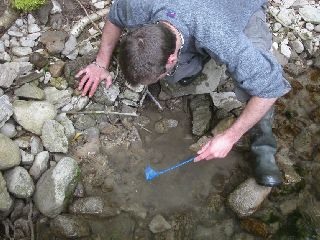
Photo 4. An environmental
science student, Jérémy Martin, collects young signals (TL 2.2 to
3.1 cm) from scree along the stream’s west bank below Chauvilly
bridge. Around him, adult signals were found in burrows at the
water’s edge and beneath large stones.
Cessy, May 2006.
|
In October 2005 the Cessy
angling club (APEC) urged that an environmental assessment be made
of non-indigenous crayfish species (NICS) in Cessy pond and that a
brief review be made of the crayfish situation in other parts of
Cessy parish. The latter study, which is discussed herein, was
directed at the Oudar stream, the southern tributary of the R.
Versoix, which drained into Lake Léman at Versoix (north of Geneva
in the Swiss canton of Vaud). It was also the only upland stream in
the parish that was perennial and had a history of crayfish
occupation.
In former times the
white-clawed crayfish (Austropotamobius pallipes) inhabited the
stream but by the end of the 20th century that species had
apparently been replaced by the signal crayfish Pacifastacus
leniusculus and the spiny-cheek crayfish Orconectes limosus (Anon,
2005).
Basic features of Cessy
parish
Cessy parish is located to
the south of Gex town in the Pays de Gex of the French Department of
Ain. It spans the main road from Ferney Voltaire (and Geneva) in the
south, to Gex (and Paris) to the north-west. Some basic features of
its geography and hydrography are presented in Figure 1.

Figure 1. Map showing the
basic geographical and hydrographical features of Cessy parish. Dark
gray shading denotes settled and developed areas, while lighter
shading denotes agricultural land and areas of natural vegetation.
The crayfish found in 2005
and 2006
Crayfish were
first caught in October 2005, in the Maraichet (a rivulet tributary
of the main stream that traversed Cessy’s Chauvilly suburb). They
were all juveniles whose identity was not immediately apparent.
However, in 2007 when
juvenile spiny-cheeks (from Cessy pond parents) were examined, it
was noted that their claws quickly developed orange and black
banding patterns of a type that had not been seen in the Maraichet
specimens. Thus it was concluded that the Maraichet juveniles were
all signals.
In 2006, breeding
populations of both signal and spiny-cheek crayfish were only found
in the main channel of the Oudar in Cessy’s Les Marguerons suburb,
but not elsewhere in the Cessy parish.
Most crayfish were collected
on one of three occasions between May and July, and on each
occasion, sampling sessions were of limited duration, because the
launching of a detailed study of spiny-cheeks in Cessy pond required
priority attention.
Crayfish study techniques
Using hands, aquarium nets
and other simple implements, 56 adult signals were collected; 41
males, 15 females (two of which were berried) and several juveniles.
Fewer spiny-cheeks were caught, and none was berried.
Where shallow
water was very clear it was easy to identify crayfish without
catching them, simply because the details of their integument
colouration were so visible. This recognition technique was useful
when seeking spiny-cheeks, many of which were hard to catch. They
had an uncanny knack of avoiding capture by darting under immovable
slabs of rock.
For several autumn-spring
months when there was high precipitation and when snow on the Jura
melted, the stream became a raging torrent and crayfish sampling
activities became impracticable.
Observations on the crayfish
populations downstream of the Chauvilly road bridge
1. The varied body
coloration of signals
Early on, it was evident
that there was much variation in the dorsal integument colour and
patterning of adult signals, to the extent that we had doubts about
the taxonomic status of some specimens. However, Dr David Holdich
kindly examined specimens and verified that they were all signals.
To elaborate, based on the
appearance of their dorsal integuments, it was possible to
distinguish three colour forms of signal, as follows:
• lightly coloured and
patterned forms with hues and shades of gray, yellow, orange and
brown and with very obvious “signal” patches on the claws,
• darkly coloured and
obscurely patterned forms with shades of colour approaching black
(presumed to be due to higher levels of blue-green pigments in parts
of the integument) and without “signal” patches, and,
• like the previous
form, but with some dorsal surfaces (mainly the claws, the edges of
some leg articulations and abdominal segments) tinged and patterned
with colour in the turquoise-blue range. One individual (that evaded
capture) had vivid patterns on the dorsal surfaces of its claws,
cephalothorax and abdomen. It really was a “blue” crayfish and
matched the description of the stream’s “écrevisses bleues” that had
often been observed by a local angler.
What was disappointing was
that when “blue” individuals were removed from the stream and put
into a container of “still” water all traces of the blue-green
colours rapidly disappeared, presumably because the associated
blue-green pigments became increasing colourless due to
de-oxygenation. Furthermore, those specimens soon died (perhaps also
because of depleted dissolved oxygen in the container). From then
on, the corpses became progressively lighter and more orange-red in
colour,
No convincing explanation
can yet be offered to explain those observations. However, it is
tentatively concluded that they were associated with moulting; that
immediately after a moult, a signal was light in colour but that
during the long interval between that moult and the next it became
progressively darker. Perhaps the oldest individuals (moulting only
once a year) were the darkest ones and the only ones in which vivid
blue colour appeared.
2. The uniform body
coloration of spiny-cheeks
The body
colouration and patterning of the spiny-cheeks conformed to the
numerous descriptions that can be found in the literature on this
species.
Although blue-bluish
spiny-cheeks were found in a pond near the R. Saône, ca 150 km north
of Cessy (Monasson, 2004), no such individuals were seen in the
stream, nor were they found during extensive studies of this species
in Cessy pond (Baldry, 2007).
3. Ecological observations
A striking
ecological feature of the two crayfish species was the spatial
separation of their respective habitats, which were influenced by
both the stream’s substrate and its water flow patterns.
Flat, stepped limestone
strata dominated stream bed roughness of much of the stream;
creating both varied cross-sectional profiles and small falls and
cascades (in the linear profile). Crayfish appeared to avoid such
stream characteristics. However, in a few places, associated
elements of the petrology included small boulders, cobbles, riffles
(gravel banks), scree (of glacial moraines and of limestone),
discarded building materials and vegetal detritus. Clumps of Willow
Moss (Fontinalis sp) were also found there. In such situations
signals and spiny-cheeks were found, but there was minimal
overlapping of their respective ambits.
The rapid-flow regimes of
highly oxygenated water, dominated the central and western channels
of the stream, and were much frequented by signals. Where the
stream’s bank carried scree and cobbles, signals frequently
concealed themselves beneath large stones or in burrows which had
been excavated along the water line.
In contrast, spiny-cheeks
preferred shallow, tranquil-flow regimes of the eastern side of the
stream where they could easily seek cover under rock ledges and in
jumbled masses of cobbles and tangled vegetal detritus. In some
places the bank was largely organic in character, but there was no
evidence that spiny-cheeks had used it for making burrows.
Although no studies were
made of the feeding habits of the two crayfish, it was presumed that
their diets were made up of: a) invertebrates (aquatic stages of
mayflies, stoneflies, caddis-flies and black-flies (Simuliidae) and
the amphipod Gammarus pulex, all of which were fairly common, and b)
detritus from riparian trees, shrubs and herbs.
Miller’s Thumb (Cottus
gobio) were often caught when searches were made for signals beneath
stones. It thus seemed likely that large signals preyed on those
fish. Conversely, the fish may have preyed on young signals, since
it is known (Neveu, 2001) that they are very efficient at catching
young crayfish.
4. The reproductive cycle of
signal crayfish
It is generally agreed that
in most populations of signals, mating and egg-laying occur in
October, egg incubation time is from 166 to 280 days, and, juveniles
appear from March to July (Souty-Grosset et al. 2006). It was thus
noteworthy that berried females were taken on 15 May and on 4 July
2006, implying that the egg incubation time of the second female was
close to the upper limit of the quoted range. If that female had
become berried in early October 2005 it could have stayed in that
state for more than nine months!
One supposes that long
incubation time were required to ensure that when juveniles
separated from their mother, hydrological and biological states of
the stream offered them the best chances of survival.
|
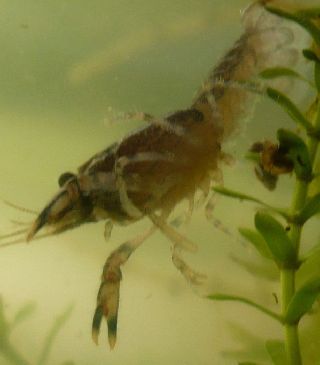
Photo 1. A juvenile
spiny-cheek exhibiting distinctive banding of the tips of its claws.
Such banding appeared in the early stages of juvenile life.
Cessy,
July 2007.
|
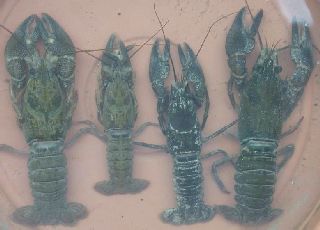
Photo 2.
Dorsal views of
adult signals showing differences in the colouring and patterning of
their integuments. Signal patches are only visible in the pale
specimens.
Cessy, May 2006.
|
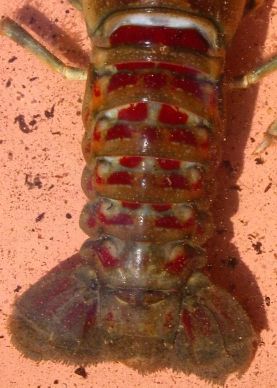
Photo 3. An adult male
spiny-cheek showing typical red patterning of the dorsal surface of
the abdomen.
Cessy, April 2006.
|
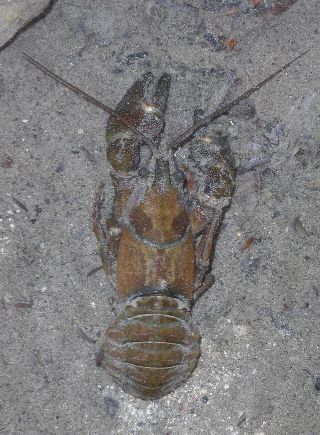
Photo 5. Lifting a large
stone along the stream’s west bank, an adult female signal was found
well settled into the underlying limestone silt.
Cessy, June 2006.
|
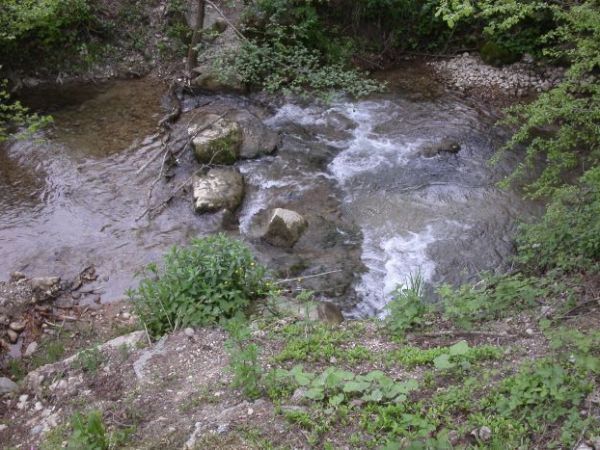
Photo 6. Part of the stream
below Chauvilly bridge, where signals occupied the turbulent,
rapid-flow regimes in the central and lower parts of the photo, and
where spiny-cheeks occupied the tranquil-flow regimes in the upper
part of the photo.
Cessy, May 2006.
|
Concluding remarks
Most of the
observations that have been summarized herein, especially concerning
signal crayfish, were not quite what we would have expected.
Furthermore, convincing and meaningful explanations for the colour
variations and for the apparently long egg incubation period of
signals, cannot yet be expounded. It is thus hoped that, among the
readers of this short article, there will be someone who is able to
throw light on some of those anomalous items.
Literature cited
Anon. (2005). Dossier de
demande de régularisation de l’enclos piscicole à vocation
touristique de Cessy. Industrial Research Assistance Program,
Annecy, 32 p. & 2 annexes.
Baldry, D. (2007). Étude de
l’écrevisse américaine Orconectes limosus (Rafinesque, 1817) dans
l’étang de Cessy, Pays de Gex, 01170 (France) : I. Objectifs,
l’étang, les techniques utilisées et quelques observations
initiales. II. Observations d’O. limosus à de faibles températures
environnementales. III. Le cycle reproductif d’O. limosus.
L’Astaciculteur de France, Bull. N° 91: 2–12, N° 92: 2–14 & N° 93:
2–13.
Monasson, C. (2004).
Existence d’écrevisses américaines (Orconectes limosus) bleues dans
une mare de Franche-Comté. L’Astaciculteur de France, Bull. N° 78:
2–6.
Neveu, A. (2001).
Experimental confrontation between resident omnivorous fish (11
species) and introduced alien crayfish (2 species). Bull. Fr. Pêche
Piscic., 361: 705-735.
Souty-Grosset, C., Holdich,
D.M., Noël, P.Y., Reynolds, J.D. & Haffner, P. (Eds) (2006). Atlas
of Crayfish in Europe. Muséum national d’Histoire naturelle, Paris
(Patrimoines naturels, 64), 187 p. ISBN: 2-85653-579-8.
|